When the security review comes, have the evidence ready.
QuickChain turns a GitHub or Bitbucket scan into the SBOM, reachability evidence, and compliance drafts a buyer, assessor, or insurer asks for.
Deterministic scans. No source code is sent to a model.
Most of your CVE queue is noise. The review still takes weeks.
Scanners surface everything. Turning that into evidence a reviewer accepts, without a translation sprint every time, is the work that actually costs you.
Sources: Datadog State of DevSecOps 2025 (runtime context on critical CVEs); industry consensus on CMMC Level 2 SSP length; 2026 State of the DIB Report, CyberSheath / Merrill Research, n=302.
From repository to review-ready evidence
What goes in, what comes out, and the fact that it is deterministic. One scan produces every artifact below.
Connect the repository
An authenticated scan reads the repository in an isolated sandbox and clears it when the job finishes.
Build the inventory
The full direct and transitive dependency tree, with versions, licenses, hashes, and provenance where it exists.
Correlate advisories
Known vulnerabilities are matched to the inventory and kept with their severity, fix data, and exploit signals.
Analyze reachability
QuickChain determines which findings your code can actually reach at runtime, and which have no path to your application.
Establish exploitability context
Each finding gets a defensible disposition, so an assessor can see why it is urgent or why it was set aside.
Package the evidence
One scan produces the SBOM, the vulnerability statements, and the OSCAL, POA&M, and SSP inputs a review asks for.
A critical CVE with no path to your code is documentation, not a fire.
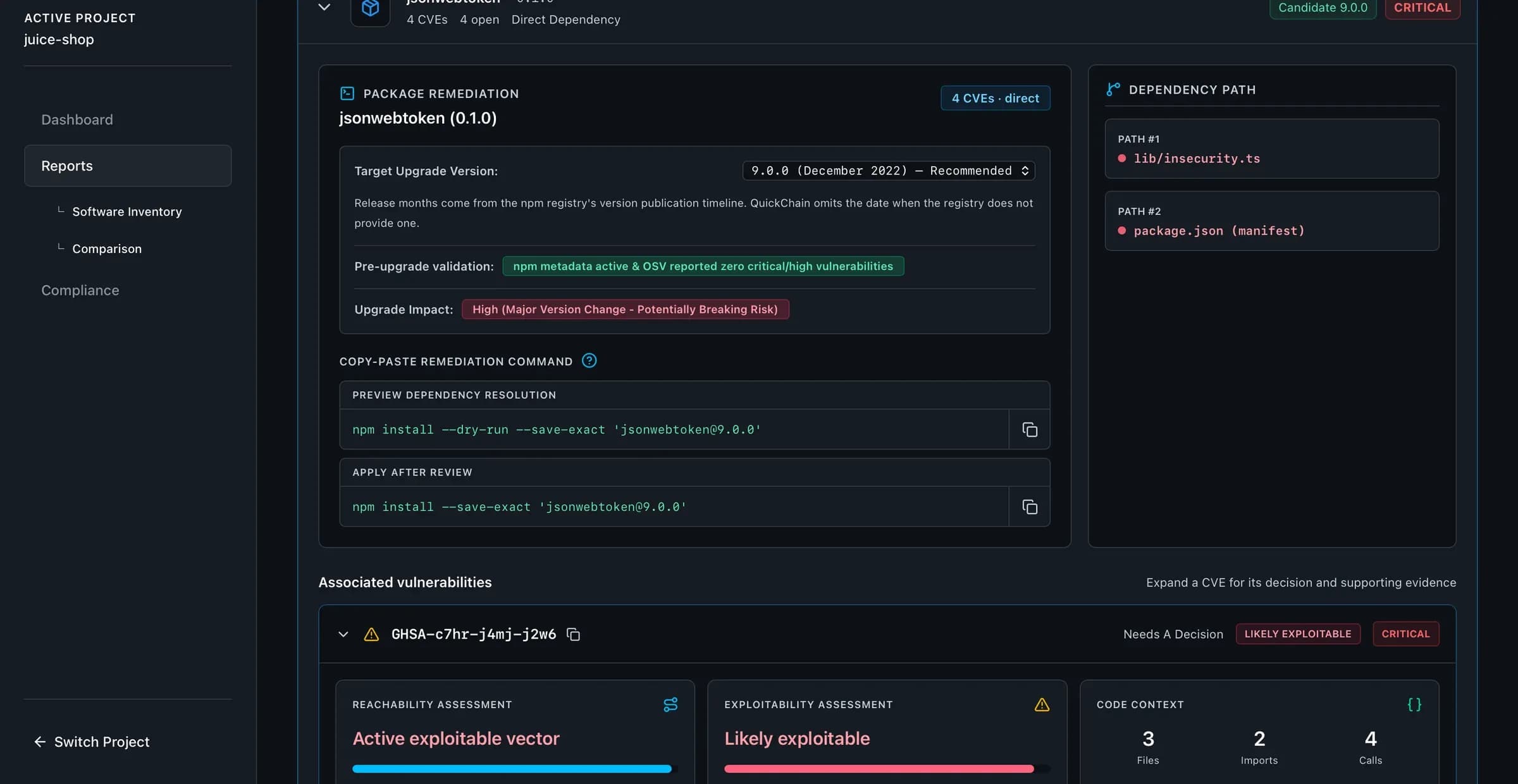
QuickChain determines which findings your application actually reaches at runtime. The ones it does not are documented as not affected, with the justification attached, so an assessor can see the reasoning.
One scan, every framework a contract names
QuickChain maps the scan to the software supply-chain controls it can back with evidence, and generates the package. Pick a framework to see what it produces.
What the scan supplies
- SSP / SCRM appendix
- POA&M workbook
- SPRS evidence summary
- SBOM
- OpenVEX statements
- Risk assessment memo
Control families it touches
QuickChain covers the software supply-chain controls, the ones behind every recent False Claims Act settlement, and produces the SSP appendix that documents them. One scan, one evidence set, reused across every framework a contract names. It is a focused technical subset, not the full control catalog, and not a certification.
Prove it on your own repository
A 90-day Audit-Readiness Pilot, $3,000, credited in full toward Year 1. It produces the evidence package your team is already being asked for, scoped to your enclave.